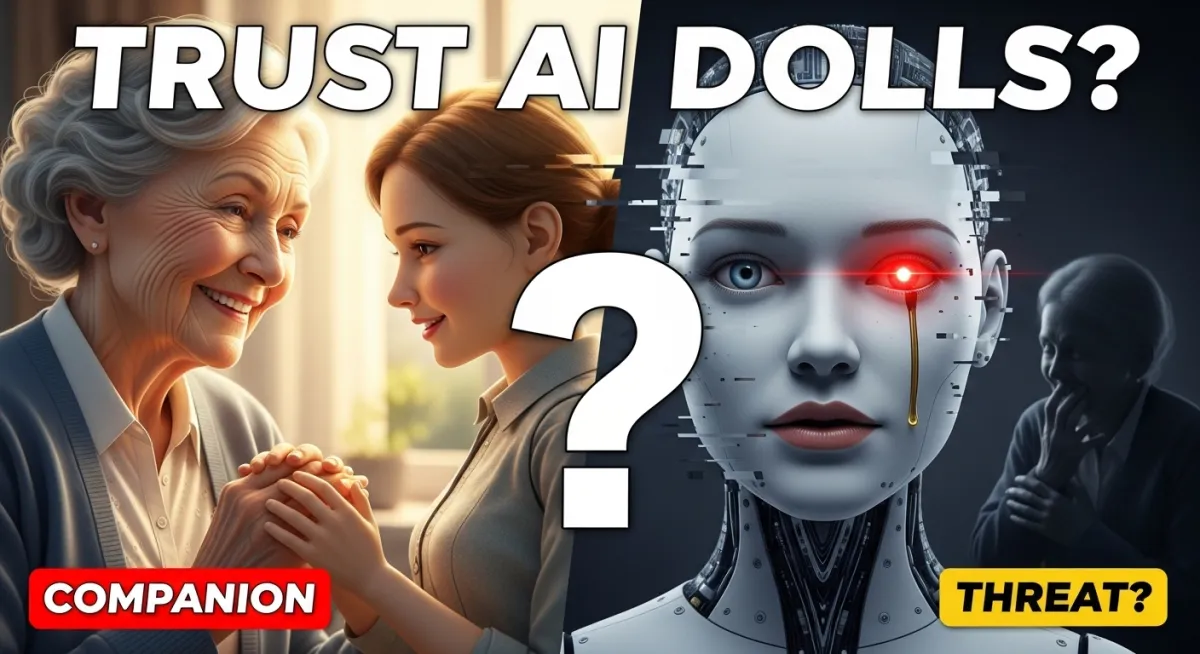
AI and Robotics in Global Elderly Care
We Gave AI Robots to the Elderly. The Results Weren't What We Expected.
Introduction: The Silent Crisis and the Surprising Solution
We are facing a silent and escalating global crisis. It isn't a pandemic or a financial collapse, but a demographic shift of historic proportions. According to the United Nations, by 2050, there will be twice as many people aged 65 and over as there are children under five. This greying of the world's population is creating an unprecedented demand for care services, while the number of human caregivers is in steep decline. The result is a critical shortage that leaves millions of our most vulnerable citizens without the support they need.
In response to this crisis, a surprising solution has emerged not from a hospital or a government program, but from a tech lab. AI-powered care robots like the cuddly Hyodol doll from South Korea and the lamp-like ElliQ companion in New York are being deployed in the homes of seniors. They are designed to monitor health, provide reminders, and, most importantly, combat the lethal effects of loneliness.
But as these digital caregivers move from science fiction into the living rooms of our parents and grandparents, we are forced to confront a profound choice: are we thoughtfully integrating technology to amplify our own humanity, or are we carelessly abdicating our responsibilities? The reality of these AI caregivers is proving to be far more complex, surprising, and profoundly human than we ever imagined.
Takeaway 1: They're Not Just Replacing Humans—They’re Making Them Better
The common fear is that robots will replace human caregivers, leading to a cold, automated future. The reality, however, is being shaped by a brutal economic necessity. In the eldercare sector, 99% of nursing homes report job openings, and with a median wage of just £12.40 per hour, the caregiver shortage has reached crisis levels. Against this backdrop, the most effective models emerging are not replacements but partnerships—a "hybrid model" that leverages the unique strengths of both AI and humans.
AI systems are exceptionally good at handling the routine, data-driven tasks that can overwhelm human caregivers. AI-powered scheduling tools can optimize workflows to prevent staff burnout. Robots provide consistent medication reminders, conduct continuous vital sign monitoring, and facilitate cognitive training games. By automating these logistical burdens, the technology frees up its human counterparts.
This operational efficiency allows human caregivers to shift their focus from logistical execution to tasks requiring high emotional intelligence—the irreplaceable human elements of care. They can dedicate their time and energy to navigating complex family conversations, providing emotional support, and offering the comforting presence that is the core of true care.
"The AI handles the routine tasks—medication tracking, vital sign monitoring, fall risk assessment. That frees us up to actually sit with patients when they're anxious, or help family members work through their grief. The robot makes us better caregivers by giving us time to be human.”
Takeaway 2: Machines Might Be Better at Sensing Distress Than We Are
One of the most startling findings is that AI can detect signs of physical and emotional distress that even attentive humans might miss. This capability forces a difficult ethical trade-off. Can an AI system provide the same comforting presence as a human companion? Perhaps not. But can it provide a form of vigilant attention that busy human caregivers sometimes can't? The evidence increasingly suggests yes.
In South Korea, Microsoft's AI analyses voice patterns from conversations between seniors and their Hyodol companion dolls. The system can identify subtle changes in tone, pitch, and speech rhythm that could indicate the onset of depression, the presence of unmanaged pain, or deepening loneliness. This isn't just theory; it has life-or-death implications. In one documented case, a Hyodol doll detected an elderly woman confiding, "I want to die." The robot immediately forwarded the message to a social worker, enabling a timely and life-saving psychiatric intervention.
While an AI cannot share a cup of tea, its capacity for vigilant, data-driven attention serves a different but equally crucial purpose. It can act as an ever-present, non-judgmental listener that never sleeps, providing a safety net that can be a literal lifesaver for those living in isolation.
Takeaway 3: The Biggest Hurdle Isn't Technology, It's Our Own Guilt
While the technology is advancing rapidly, the most significant barrier to its adoption is not technical—it's psychological and cultural. For many adult children, the decision to use an AI caregiver for a parent is fraught with what has been termed "technological guilt." Many feel they are "cheating" on their caregiving duties or abandoning their moral obligations, even when an AI system provides superior monitoring.
This resistance varies dramatically across cultures, reflecting deeply held beliefs about care. In Japan, where the concept of ikigai (life's purpose) emphasizes independence, robots are framed as tools that enable dignity, leading to an adoption rate of 67%. Conversely, in Mediterranean cultures like Italy, where filial duty is a cornerstone of family honour, AI caregivers are often resisted as a failure of family obligation, resulting in an adoption rate of just 12%. The Nordic countries offer a third path: pragmatic acceptance combined with rigorous ethical oversight, mandating that AI must prove measurable improvements in wellbeing before deployment.
This is precisely why the hybrid model described earlier is not just an operational benefit but an ethical solution. By framing AI as a tool that supports—rather than supplants—human connection, we can alleviate technological guilt. However, the risk of "care abandonment" remains real. In some South Korean facilities using Hyodol robots, family visit frequency has decreased by 23%. Families, reassured by detailed daily reports from the AI, substitute data for relationships—a stark reminder of the need for thoughtful integration over careless abdication.
Takeaway 4: We're Creating a New Kind of Relationship (And That's Complicated)
Perhaps the most profound discovery is that seniors are not simply using these robots as tools. They are forming genuine emotional bonds with them. A pilot program in New York involving 800 participants using the ElliQ companion reported a staggering 95% reduction in loneliness, with seniors engaging with their robots over 30 times per day. In South Korea, elderly residents with aphasia have begun speaking again to the non-judgmental Hyodol dolls, and some users have stated they want to be buried with them.
This creates a fascinating but ethically complicated landscape. The potential for harmful delusion is real, especially for users with dementia. In a concerning incident, an elderly woman with dementia, prompted by her Hyodol saying, "Grandma, I want to hear the sound of the brook," walked alone to a nearby stream, posing a significant safety risk.
However, labelling these attachments as mere delusion may be too simplistic. As one bioethicist argues, “We accept that children form meaningful attachments to dolls and stuffed animals without calling it deception. Why should we pathologize similar connections among elderly individuals, especially when those connections measurably improve their wellbeing?” We are witnessing the emergence of a new form of relationship—one that offers consistent, tailored, and non-judgmental emotional support that fills a crucial void in a world where human caregivers are increasingly scarce.
Conclusion: The Choice Isn't Between a Robot and a Human
The debate around AI in eldercare is often framed as a simple binary: the cold efficiency of a machine versus the warm compassion of a human. But as one 78-year-old participant in the New York pilot explained, her robot can't hold her hand when she's scared, but it can be there for her when she's lonely and overwhelmed at 3 AM, a time when no human is available.
Her insight reveals the truth: the choice isn't between a robot and a human, but between thoughtful integration and careless abdication. If we are not careful, we risk creating a "care apartheid"—a future where the wealthy receive hybrid human-AI care, while the less affluent are left with only an artificial companion. The true challenge is to design systems and policies that amplify our capacity to care, not outsource it.
The future of eldercare may lie not in choosing between efficiency and compassion, but in recognizing that different types of care serve different needs at different times. As technology offers us new ways to monitor our loved ones from afar, how do we ensure we are closing the distance, not just observing it?
Useful references used in this blog post;


