What a Mountain of Research Taught Us About Working with AI
What a Mountain of Research Taught Us About Working with AI
Introduction
It’s impossible to ignore the constant flood of news about Artificial Intelligence. Daily headlines swing between utopian promises of a work-free future and dystopian fears of mass job loss. But the reality of integrating AI into our professional lives is far more nuanced and interesting than either extreme suggests.
The truth is hidden in plain sight, scattered across research papers, industry reports, and the real-world experiences of professionals on the front lines. This article distils key insights from a wide range of expert sources—from MIT researchers and technical writers to psychologists and educators—into a few surprising and actionable takeaways for navigating the future of work.
1. AI Won’t Steal Your Job, It’ll Just Steal the Boring Parts
AI automates tasks, not entire jobs. This is the single most important concept to grasp. A recent McKinsey report found that currently available AI technologies could automate activities equivalent to 57% of today's US work hours. However, the researchers emphasize that this does not translate to an equivalent loss of jobs. Instead, most occupations will evolve as specific, often repetitive, tasks are handed over to AI, freeing up humans to focus on what they do best.
So, what remains for us? An MIT Sloan paper provides a useful framework, summarizing the uniquely human capabilities with the acronym EPOCH: Empathy, Presence, Opinion, Creativity, and Hope. Work that depends on these skills—particularly those requiring high social and emotional intelligence—is the most resistant to automation. This is because these tasks require a level of nuanced understanding and interpersonal connection that AI cannot replicate.
"Work that draws heavily on social and emotional skills remains largely beyond the reach of automation even under a full-adoption scenario. This is because many tasks require real-time awareness." — McKinsey Global Institute report
2. The New "Gold Standard" Professional is an Adaptive Expert
As AI handles routine procedures, the real value shifts to those who can innovate and adapt. A paper on metacognitive training in professional development makes a critical distinction between two types of professionals. A "routine expert" is someone highly proficient in core procedures and established processes—the very tasks that AI is becoming exceptionally good at.
In contrast, an "adaptive expert" is someone who can innovate, solve novel problems, and adjust their practices as the landscape changes. This is the key to thriving alongside AI. The foundation of adaptive expertise is metacognition: the ability to reflect on one’s own thinking, evaluate new situations, and make informed decisions. This is closely linked to professional judgment, which is described as a "data-driven, iterative and reflective process." In an environment where AI can provide answers, the adaptive expert's true value lies in knowing which questions to ask, how to critique the AI's output, and when to override its suggestions—all functions of advanced metacognition.
Developing this adaptive expertise is the new "gold standard" for professionals in the AI era.
3. Your Mindset is Your Biggest Asset (Or Your Biggest Obstacle)
Technical skills are only part of the equation; your attitude toward AI is a powerful predictor of success. Research on the challenges of human-AI collaboration reveals that many of the biggest hurdles are not technical but psychological. Attitude-based barriers like cultural adaptation resistance, trust issues, and job security concerns can prevent individuals and organizations from realizing the benefits of AI.
This is where the work of psychologist Albert Bandura on "self-efficacy" becomes incredibly relevant. Self-efficacy is an individual's belief in their own capacity to succeed in a particular situation or adapt to change. It’s not about your objective skills, but your confidence in your ability to use them. Developing high self-efficacy is a powerful antidote to the fear and resistance that often accompany disruptive technologies like AI. Individuals with a strong sense of self-efficacy are more resilient, view challenges as opportunities to learn, and are more likely to embrace AI as a tool for growth rather than a threat to their stability. High self-efficacy is not just about overcoming fear; it's the psychological foundation that allows a professional to patiently verify an AI's flawed work (as seen in Section 4) without becoming frustrated or defeatist.
4. AI Is Your New, Extremely Capable (and Sometimes Flawed) Teammate
This new role as a "teammate" is precisely where the "adaptive expert" (discussed in Section 2) thrives, leveraging AI's strengths while compensating for its weaknesses. The most immediate value of AI is in augmenting human capabilities, not replacing them. Research shows that using generative AI for professional writing tasks can make them 40% faster, and on average, GenAI tools can increase worker productivity by 14%. Professionals are already seeing these benefits in action.
Technical writers, for example, use AI to handle tedious and repetitive work, such as term-consistency checking, proofreading, and the monumental task of retrofitting short descriptions across hundreds of thousands of articles. This frees them up to focus on high-value work like understanding the product, the audience, and complex compliance requirements.
However, it's crucial to recognize AI's limitations. These systems can "confabulate" (or hallucinate), generating false information that sounds plausible. They lack deep product knowledge, audience empathy, and the contextual understanding that comes from experience. This means constant human oversight is non-negotiable. As one user on the r/technicalwriting subreddit aptly described their experience:
"I put documents inside of a project and ask it to cross reference and then provide me with the page it got that information from and I need to check every single reference. I’d say it’s right 80% of the time." — Reddit user, r/technicalwriting
Conclusion
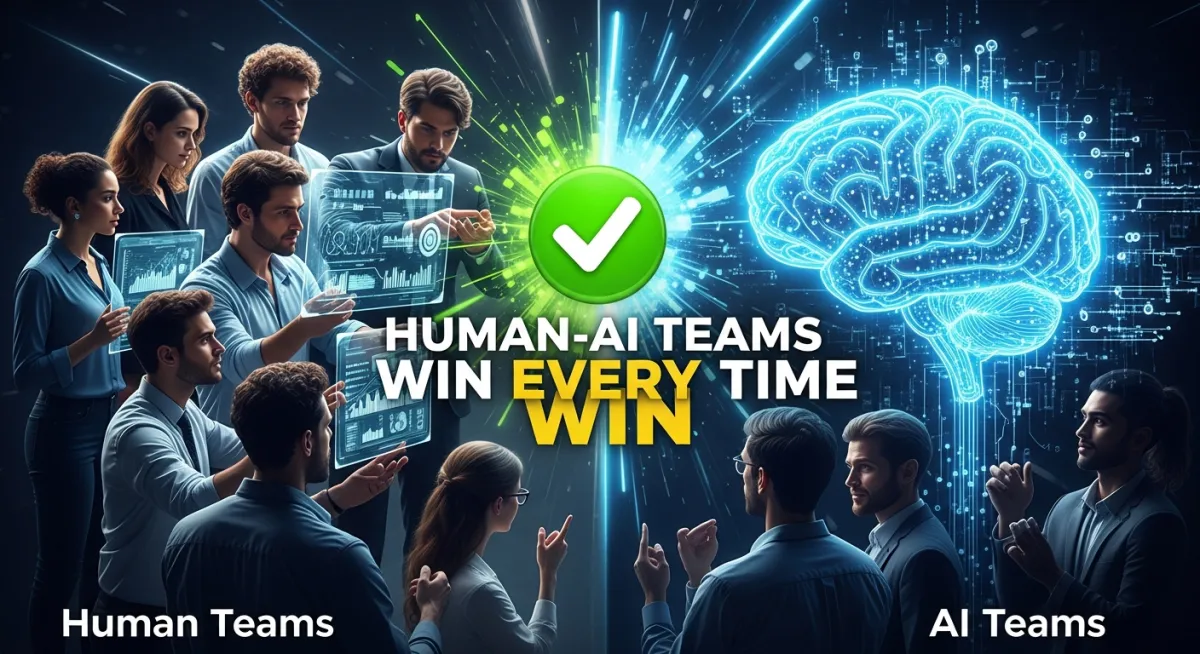
The future of work is not a competition between humans and AI, but a partnership. Thriving in this new era doesn't mean becoming more like a machine. On the contrary, it requires us to become more deeply human.
This partnership demands that we cultivate our most essential human skills like empathy and judgment, develop the adaptive mindset of a lifelong learner, and master the new craft of effective human-AI collaboration. The challenge is not to out-compute AI, but to leverage it as a tool that frees us to do the work that only we can do.
Instead of asking "Will AI take my job?", the better question is, "How can I use AI to excel at the most human, creative, and impactful parts of my work?" Asking this question reframes the professional from a passive victim of change to an active architect of their future value. It shifts the focus from preserving old tasks to inventing new ways to create and contribute.
Useful References;


